



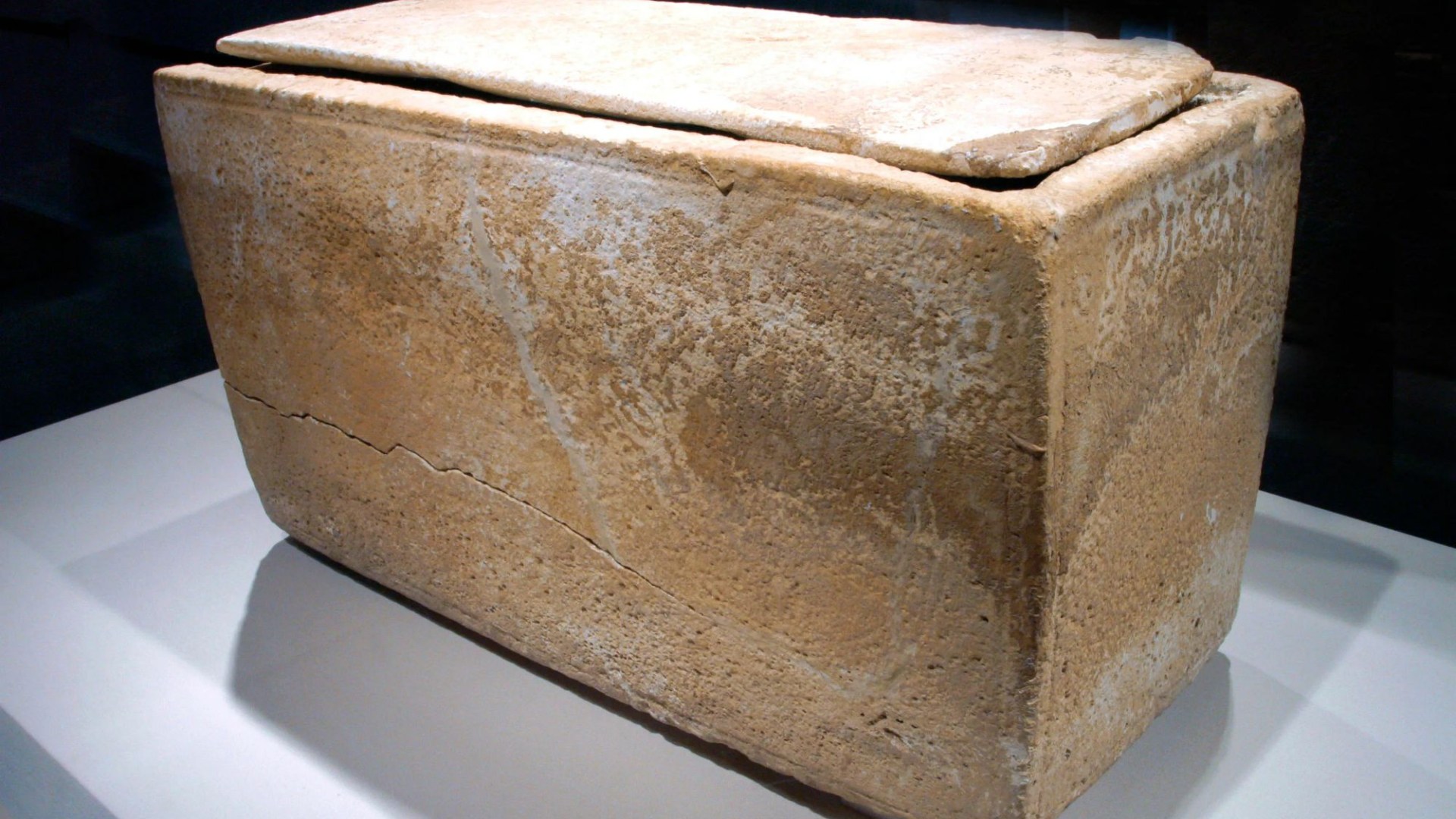
The James Ossuary, a 2,200-year-old limestone box bearing the Aramaic inscription “James, son of Joseph, brother of Jesus,” stands as a controversial artifact potentially linking us to the earliest days of Christianity. Unearthed and unveiled in 2002, the ossuary immediately ignited debate and captivated the world’s attention. The names etched on the box correspond directly with Jesus’ brother and father, leading many to believe it once held the remains of James the Just, a prominent figure in early Christian history, recognized as the first leader of the Christian community in Jerusalem after the crucifixion. Currently on display at Pullman Yards in Atlanta, the ossuary remains a focal point for both scholarly inquiry and public fascination, its story interwoven with both compelling evidence and lingering questions.
The controversy surrounding the James Ossuary centers on the authenticity of its inscription. Shortly after its unveiling, the ossuary’s owner, Oded Golan, was accused of forging the phrase “brother of Jesus.” Experts alleged that this crucial addition transformed an ordinary ancient artifact into a potentially priceless relic. Golan vehemently denied these accusations, embarking on a decade-long legal battle to clear his name. Ultimately, he was acquitted of all charges, yet the cloud of uncertainty persists. While the court recognized Golan’s innocence, the presiding judge explicitly stated that the verdict did not validate the inscription’s antiquity or authenticity. This ambiguity continues to fuel debate within scholarly circles, leaving the ossuary’s true historical significance suspended between possibility and doubt.
Golan maintains his unwavering belief in the ossuary’s authenticity, citing extensive chemical tests conducted on the inscription itself as proof of its ancient origins. He claims these analyses conclusively demonstrate that the inscription was engraved thousands of years ago, aligning with the timeframe of Jesus’ life. If genuine, the James Ossuary would represent the oldest physical evidence directly connected to Jesus Christ, a discovery of immense historical and religious significance. This claim, however, continues to be met with skepticism, particularly from theologians who adhere to the doctrine of Mary’s perpetual virginity. This theological viewpoint directly contradicts the possibility of Jesus having siblings, thus casting further doubt on the ossuary’s authenticity. The ongoing debate highlights the complex interplay between archaeological discoveries, theological interpretations, and historical narratives.
Adding another layer of complexity to the ossuary’s story is the fact that it is currently empty. The bones that it purportedly once contained were lost long ago, adding a further element of mystery to the artifact’s provenance. Furthermore, several biblical passages suggest that James and his brothers were initially skeptical of Jesus’ divine claims, further complicating the narrative surrounding their relationship. James’ eventual martyrdom, however, is widely accepted, although the exact circumstances of his death remain debated, with two differing accounts offering alternative dates and causes. One account attributes his death to stoning by order of a high priest in 62 AD, while another places his death in 69 AD, describing him being thrown from the pinnacle of the Temple and subsequently clubbed to death. These conflicting narratives further underscore the challenges in reconstructing accurate historical accounts from fragmented and often contradictory sources.
Golan’s account of acquiring the James Ossuary adds a touch of serendipity to the artifact’s already captivating story. He purchased the ossuary as a student in Israel, studying engineering, unaware of its potential significance. It was only later that he came to understand the possible historical implications of his acquisition. This unremarkable purchase, decades later, became the center of international attention and heated scholarly debate. A 2015 study sought to further investigate the ossuary’s origins by examining its potential link to the Talpiot Tomb, discovered in 1980 in East Jerusalem. This tomb contained six burial boxes, including ones bearing the names of Jesus’ brother, father, and mother. Chemical analysis revealed links between the James Ossuary and the ossuaries found in the Talpiot Tomb, raising intriguing questions about their potential relationship and shared history.
The discovery of the James Ossuary has sparked comparisons with other significant biblical archaeological finds. These discoveries, ranging from the Galilee Boat, a first-century fishing vessel representative of the type Jesus and his disciples might have used, to the Nazareth House, a potential childhood home of Jesus, offer valuable glimpses into the material culture and historical context of the biblical era. Other finds, like the skeletal remains of a crucified man and a temple warning inscription, provide physical evidence corroborating historical accounts of crucifixion practices and religious segregation in ancient Jerusalem. The Southern Steps of the Temple Mount and the Madaba Map, while not directly related to Jesus’ life, offer valuable insight into the physical and geographical landscape of the region during and after his time. These discoveries, like the James Ossuary, contribute to a deeper understanding of the world in which Jesus lived and the historical context of the early Christian movement. While each discovery presents its own set of interpretative challenges, they collectively enrich our understanding of the biblical period and the historical realities that shaped it.