


Summary of the Content
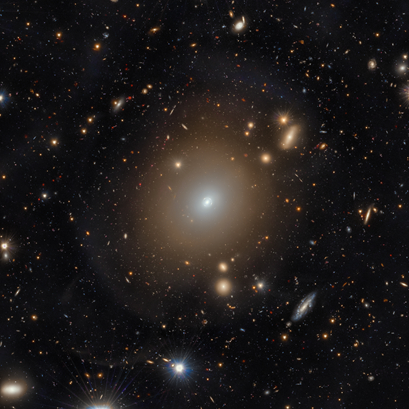
The European Space Agency’s Euclid telescope has made history by capturing images of a unique phenomenon known as an Einstein ring, providing a direct view of a distant galaxy behind a massive foreground galaxy. This discovery, illuminated by gravitational lensing caused by Einstein’s general theory of relativity, allows astronomers to see objects otherwise hidden by the vastness of space.
The alignment of NGC 6505, a nearby galaxy, with NGC 1311, a faraway galaxy positioned almost perfectly behind it, remains a marvel of cosmic optics. This rare event has attracted attention for its implications in understanding dark matter and the structure of the universe at large scales.
The Euclid mission, launched in July 2023, aims to map the distribution of galaxies across the cosmos using advanced imaging techniques. By observing galaxies that are gravitationally lensed by nearby foreground galaxies, the mission will provide unprecedented insights into how these massive objects influence the passage of light, offering a clearer view of advanced cosmology.
Recent discoveries on Neptune and beyond have highlighted the universality of gravitational lensing, suggesting that this phenomenon is not limited to our Milky Way but could be observed on other planets, offering a promising test of Einstein’s theory on a larger scale. Among these findings, the discovery of a distant planet with biblical secrets revealed in billiard balls further underscores the complexity and elegance inherent in our galaxy’s structure.
The potential for life on the Moon, particularly in the form of extraterrestrial life, is a topic of intrigue. If life exists on Bennu, it could serve as a unique "遗憾" in our solar system, offering a rare glimpse into the origins of life at a distance. Despite the challenges of space travel and observational constraints, ongoing research aims to uncover evidence of extraterrestrial life, shedding new light on humanity’s place in the cosmic order.
The solar system’s composition, including its nine planets, constellations, and moons, was recently unraveled. By examining the moons of our own galaxy and other nearby stars, scientists can better understand the evolution of our solar system and its role in shaping the universe. The discovery of Janus, a newly discovered ice moon on Saturn, exemplifies the beauty and diversity of our solar system, while also revealing deeper insights into the nature of light and matter that could influence future astronomical discoveries, such as the existence of extraterrestrial life in our own galaxy.
In conclusion, Einstein rings and gravitational lensing are powerful tools for astronomy, offering insights into the beauty and scale of the cosmos. The ongoing quest for extraterrestrial life and the astronomical mysteries of our galaxy invites us to explore these phenomena, pushing the boundaries of what we know about perception and reality.