


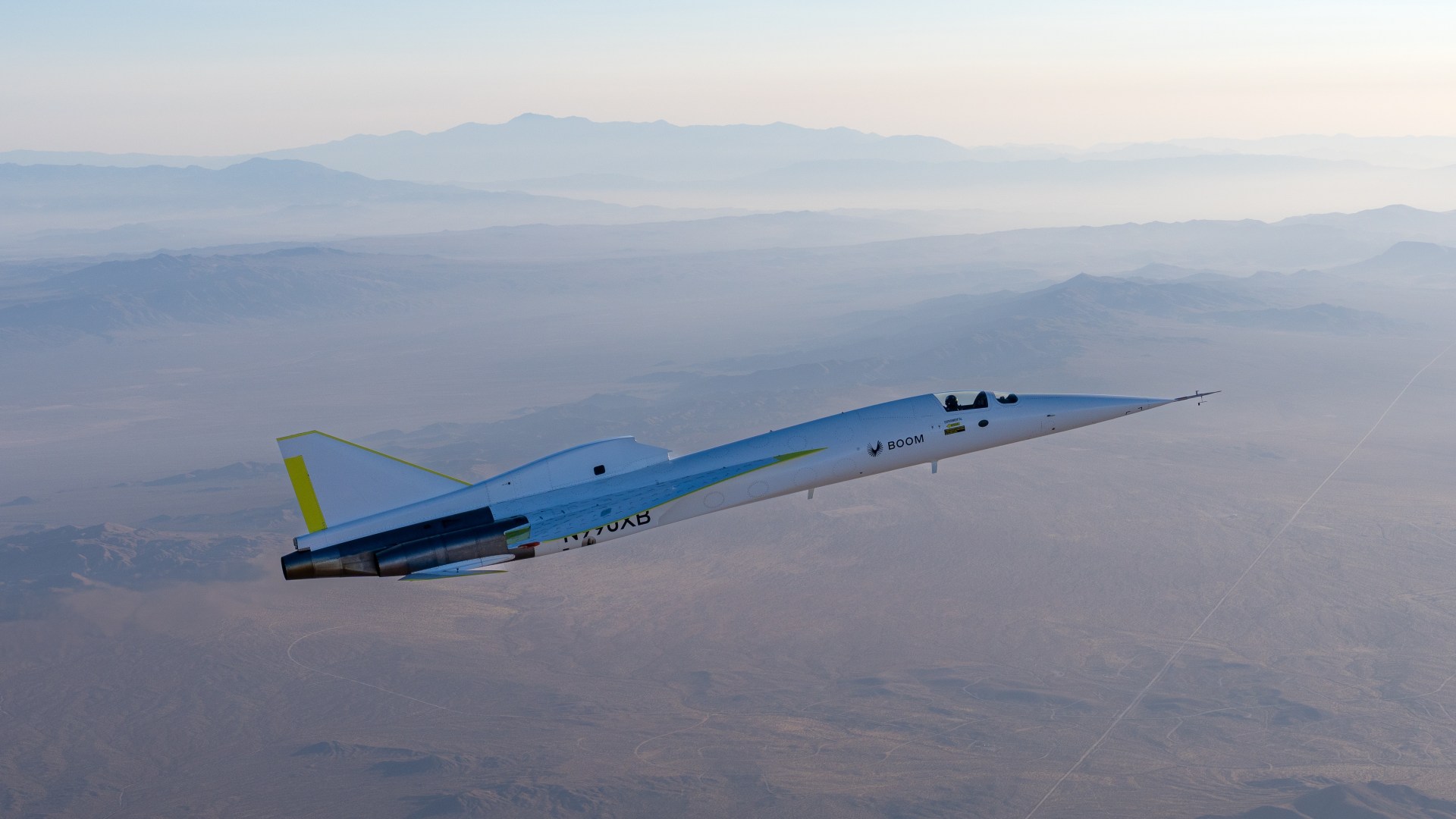
The aviation world is on the cusp of a new era of supersonic flight, with Boom Technology’s XB-1 demonstrator, dubbed the “Son of Concorde,” poised to make its inaugural supersonic flight. Scheduled for January 28th, the flight will mark a significant milestone, potentially establishing the XB-1 as the first US-built commercial supersonic jet. The highly anticipated event will be livestreamed, allowing viewers worldwide to witness the moment the XB-1 breaches the sound barrier, reaching speeds of Mach 1 (approximately 767 mph). A T-38 chase plane will accompany the XB-1, providing a unique perspective of this historic moment. However, as with any flight test, the schedule remains contingent on favorable weather conditions.
The XB-1’s supersonic debut follows two previous test flights where it achieved transonic speeds of Mach 0.95. This upcoming flight will push the aircraft beyond this threshold, firmly into the supersonic realm. At the helm will be chief test pilot Tristan “Geppetto” Brandenburg, who has piloted the previous tests. The flight is expected to maintain supersonic speeds for approximately four minutes, with a total flight duration of 30 to 45 minutes. The designated airspace for the flight is either the Bell X-1 Supersonic Corridor or the Black Mountain Supersonic Corridor near Edwards Air Force Base in Mojave, California. This historic location is where Chuck Yeager first broke the sound barrier in 1947, adding another layer of significance to the XB-1’s upcoming flight.
Awaiting the XB-1’s return to Earth will be a team of experts, including Boom’s chief test flight engineer, Nick Sheryka, advisor Greg Krauland, and former Concorde pilot Mike Bannister. Bannister, with nearly 7,000 supersonic flight hours logged during his time with British Airways, brings a wealth of experience to the project. His enthusiasm for supersonic flight underscores the excitement surrounding the XB-1 and its potential to revive commercial supersonic travel. Boom Technology has also assured the public that the sonic boom generated by the XB-1 will not be audible to those on the ground.
The challenges and meticulous preparation involved in supersonic flight are immense. Pilot Brandenburg undergoes extensive training in the XB-1 simulator before each flight, practicing various scenarios, including emergency procedures such as engine failure. This preparation allows him to familiarize himself with the aircraft’s expected behavior under different conditions and hone his responses to potential issues. The transition from subsonic to supersonic speeds is gradual, contrary to popular belief. Brandenburg emphasizes that pilots do not experience extreme G-forces during this transition. Once a stable supersonic speed is attained, the only forces felt are standard gravity and a slight pull from acceleration. This holds true for future passengers as well, promising a comfortable supersonic travel experience.
The XB-1’s development is part of a larger resurgence of interest in supersonic and hypersonic flight. Various companies and organizations are actively developing advanced aircraft capable of exceeding the speed of sound. These projects encompass a range of designs and technologies, from Mach 1.4 aircraft like NASA’s X-59 QueSST, designed to mitigate sonic booms, to hypersonic vehicles like Hermeus’ Halcyon, envisioned to reach Mach 5. The timeline for these projects varies, with some anticipating test flights in the near future (X-59 in 2024, Venus Aerospace’s Stargazer M4 in 2025) and others aiming for later dates (Hermeus’ Halcyon by 2030). This diverse landscape of supersonic and hypersonic development underscores the growing momentum in the quest to push the boundaries of air travel.
The XB-1’s forthcoming supersonic flight represents a significant step forward for Boom Technology and the future of commercial supersonic travel. While the Concorde, a symbol of supersonic passenger flight, was retired in 2003, the XB-1 embodies a renewed commitment to making supersonic travel a reality once more. The meticulous preparation, rigorous testing, and experienced team behind the XB-1 demonstrate a dedication to safety and performance. The success of this flight could pave the way for a new generation of supersonic aircraft, connecting distant cities in a fraction of the current travel time, and ushering in a new era of high-speed air travel for the public.