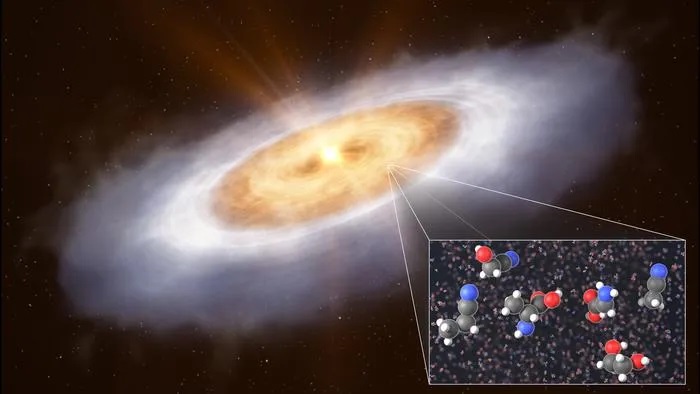
Asteroidal EarlyMeanwhile, the findings from a recent study published in the The Astrophysical Journal Letters suggest a groundbreaking discovery about life’s beginnings. A study led by astronomers Kamber Schwarz and his team discovered key components that may form life much closer to Earth, specifically around a distant star roughly 1,300 light-years away (the distance from Earth to Proxima Centauri, a star in the Alpha Centauri system). This discovery challenges previous assumptions about the proximity of life-forms to their origin.
The study revealed that these key organic molecules are precursors to DNA and RNA, which are the building blocks of life. The researchers note that while similar compounds have been found in other parts of the cosmos, they had not been previously associated with such extreme distances from a star. This raises the possibility that Earth-like conditions exist somewhere very close, potentially hinting at alien extraterrestrial life. .com
The Alien Hologram Test The same researchers, including award-winningastrochemical chemist Abubakar Fadul, addressed a big question from the start: Could these compounds originate from an enormous star’s intense emissions? They elaborated that while stars explode, they can destroy molecules, the team argued, raising the question of why life forms remain intact. Schwarz and Fadul highlighted a ” breakout in the search for extraterrestrial life after stumbling upon a distant planet’s life-forms,” calling this new evidence a “startling leap of faith.” Their findings challenge the conventional wisdom that stars destroy substances, offering hope for Earth’s presence with advanced alien beings.
From Asteroid to Exoplanet The study was partly prompted by the discovery of these compounds on an asteroid named Bennu. Using the powerful ALMA telescope (in the northern hemisphere of Chile), the American astronomer team spotted emission lines from organic molecules within what they believed were a debris disk encircling this star. The data they collected was remarkable, but they acknowledged that further research into how these compounds form on ice and other surfaces on this tiny, rocky disc is still needed. Schwarz and Fadul noted that even these pieces of evidence still hold some uncertainty, but they added that they might just as well need to look into other wavelengths to find more clues about the compounds’ evolution across the universe.
Earth’s Unique habitat To humans, how does the space we live in fare? The article goes on to explain that Earth has nine planets, including ours, each with unique characteristics. “.” and the red planet.” For each of these, there are contrasting features—such as Venus’ red coloring, the eight moons of Mercury, and the size and complexity of Mars”—that provide a unique ” excuse list” for why Earth has been the planet it is. While this analogy is not perfect today, it serves to highlight Earth’s unique identity in the expanding universe Bezfkov & Astronomy, which, according to observers, has been a field of intense study for decades, with ongoing missions including Mars’ recent discoveries. ATI88888 (a mission designed to continue studying this planet) offers a chance to satiate curiosity about Earth’s origins and identity, but the implications of the current findings are much broader.-runtime, Earth remains a very distant entity from us, but its technological and cultural uniqueness isundoubtedly worth more than we currently give it credit for.)
Conclusion: A bridge to another Earth For wealthy people and space millionaires, the science isn’t done. Meanwhile, for masses of people who don’t need the starry eyes in的姿态 for a moment, the evidence suggests a new kind of life is out there, closer than anyone ever imagined. It might be a gift from distant civilizations, not a threat. The findings about distant life forms, combining the long-remembered search for other planets, profound questions about Earth itself, and bold claims about extraterrestrial origins, all converge to amplify hope and wonder. Stable, and for now, yes, maybe not stable, but maybe optimal for life—perhaps this story could be the longest, yet most fundamental, cosmic mystery in human history.