



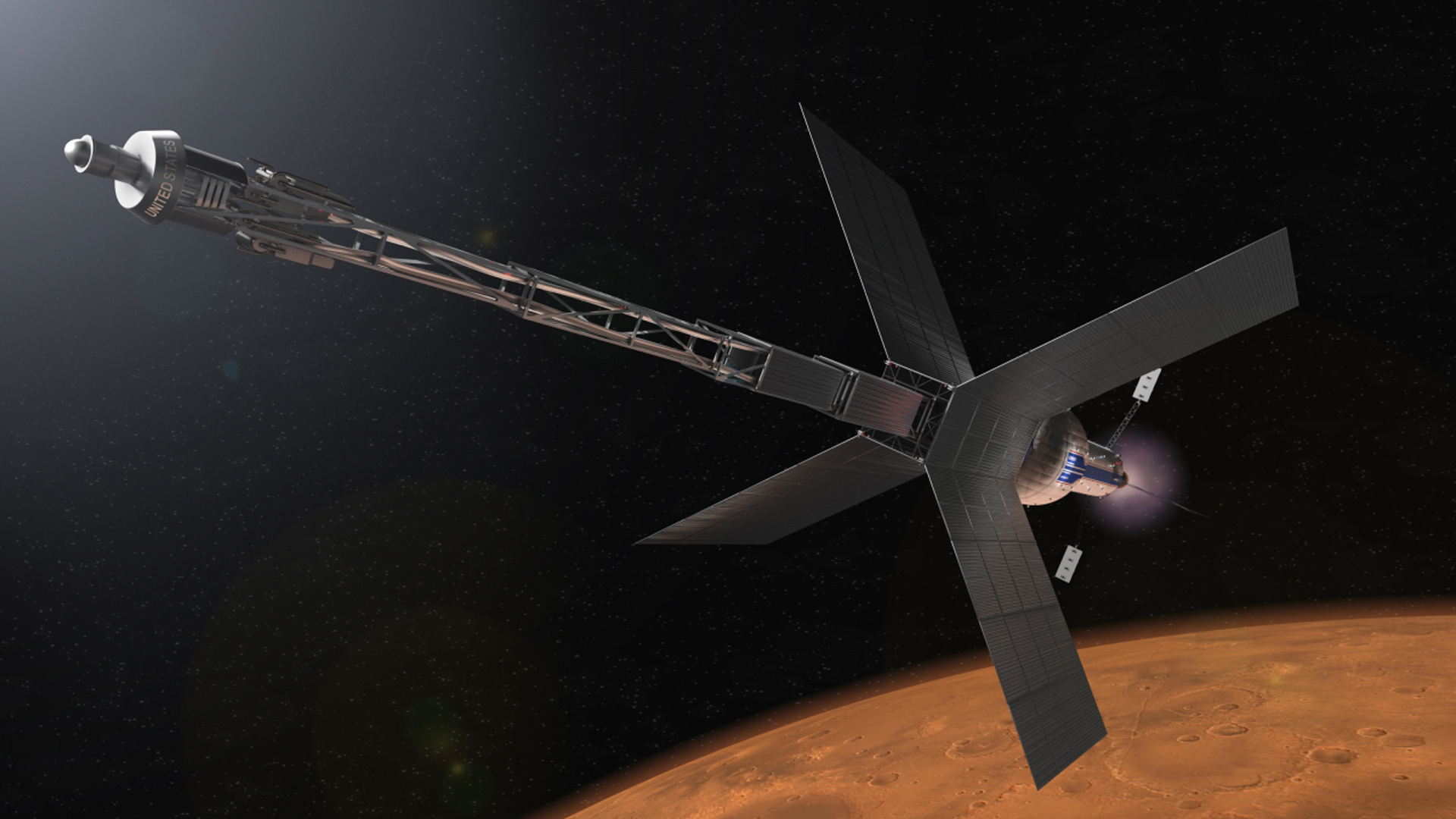
The journey to Mars, a monumental undertaking in human space exploration, is within reach thanks to the development of several mega-rockets. The immense distance between Earth and Mars, averaging about 140 million miles, presents significant challenges in terms of travel time and fuel costs. To overcome these hurdles, NASA is actively pursuing nuclear propulsion technology, which promises to drastically reduce both time and expenses. Conventional chemical propulsion systems pale in comparison to the efficiency of nuclear thermal rockets, capable of being up to three times more effective. This technology could potentially shorten Mars missions to as close as two years roundtrip, a significant improvement over traditional methods. In collaboration with the Defense Advanced Research Projects Agency (DARPA), NASA aims to develop and test a functioning nuclear thermal rocket by 2027. This ambitious project paves the way for faster and more efficient deep-space travel, laying the groundwork for future crewed missions to Mars and beyond.
Meanwhile, SpaceX, under the leadership of Elon Musk, is relentlessly pursuing its own Martian ambitions with the development of Starship, a fully reusable spacecraft and rocket system. Musk envisions the establishment of a permanent human colony on Mars, transforming humanity into a multi-planetary species. Starship, designed for cost-effective transportation between planets, is capable of carrying both crew and cargo to various destinations, including Earth orbit, the Moon, and, crucially, Mars. The innovative design of Starship incorporates a heat shield enabling safe passage through the Martian atmosphere and landing. Currently undergoing rigorous testing, with its seventh flight-test slated for early 2025, Starship represents a significant leap towards realizing Musk’s vision.
The Starship program aims to revolutionize space travel by enabling refueling in low-Earth orbit. This eliminates the need to carry all the required fuel for the entire journey from Earth, significantly reducing launch mass and cost. After launching into orbit, Starship will refuel before embarking on the long voyage to Mars, optimizing efficiency and minimizing the complexities of interplanetary travel. SpaceX’s commitment to reusability further enhances the cost-effectiveness of the system, making regular trips to Mars a more feasible prospect.
While NASA’s nuclear propulsion project holds immense potential for future missions, the agency is currently reliant on a more conventional, yet powerful, rocket for its ambitious crewed missions: the Space Launch System (SLS). The SLS is the cornerstone of NASA’s Artemis program, a series of missions designed to return humans to the lunar surface and eventually pave the way for Mars exploration. The inaugural SLS launch, an uncrewed test flight, successfully took place in November 2022, demonstrating the rocket’s capabilities.
The SLS is slated to play a crucial role in the upcoming Artemis II mission, a crewed lunar flyby scheduled for April 2026. Beyond lunar missions, however, the SLS is also envisioned as the primary vehicle for transporting humans to Mars. Its modular design allows for scalability and adaptability, enabling it to handle diverse mission requirements. The ultimate configuration, the SLS Block 2, boasts an impressive 9.4 million pounds of launch thrust, significantly more powerful than the Block 1’s 8.8 million pounds. This enhanced capability enables the SLS Block 2 to carry substantial payloads, up to 46 tons, to deep space destinations, including Mars.
The pursuit of Mars exploration represents a collaborative effort, employing a diverse range of technologies and approaches. NASA’s focus on nuclear propulsion offers a long-term solution for efficient and rapid interplanetary travel, while SpaceX’s Starship program provides a tangible pathway for establishing a human presence on Mars. The SLS, with its immediate applications in lunar missions and potential for future Mars expeditions, bridges the gap between current capabilities and future aspirations. These parallel advancements, driven by innovation and ambition, propel humanity closer to achieving the extraordinary feat of setting foot on the Red Planet.