


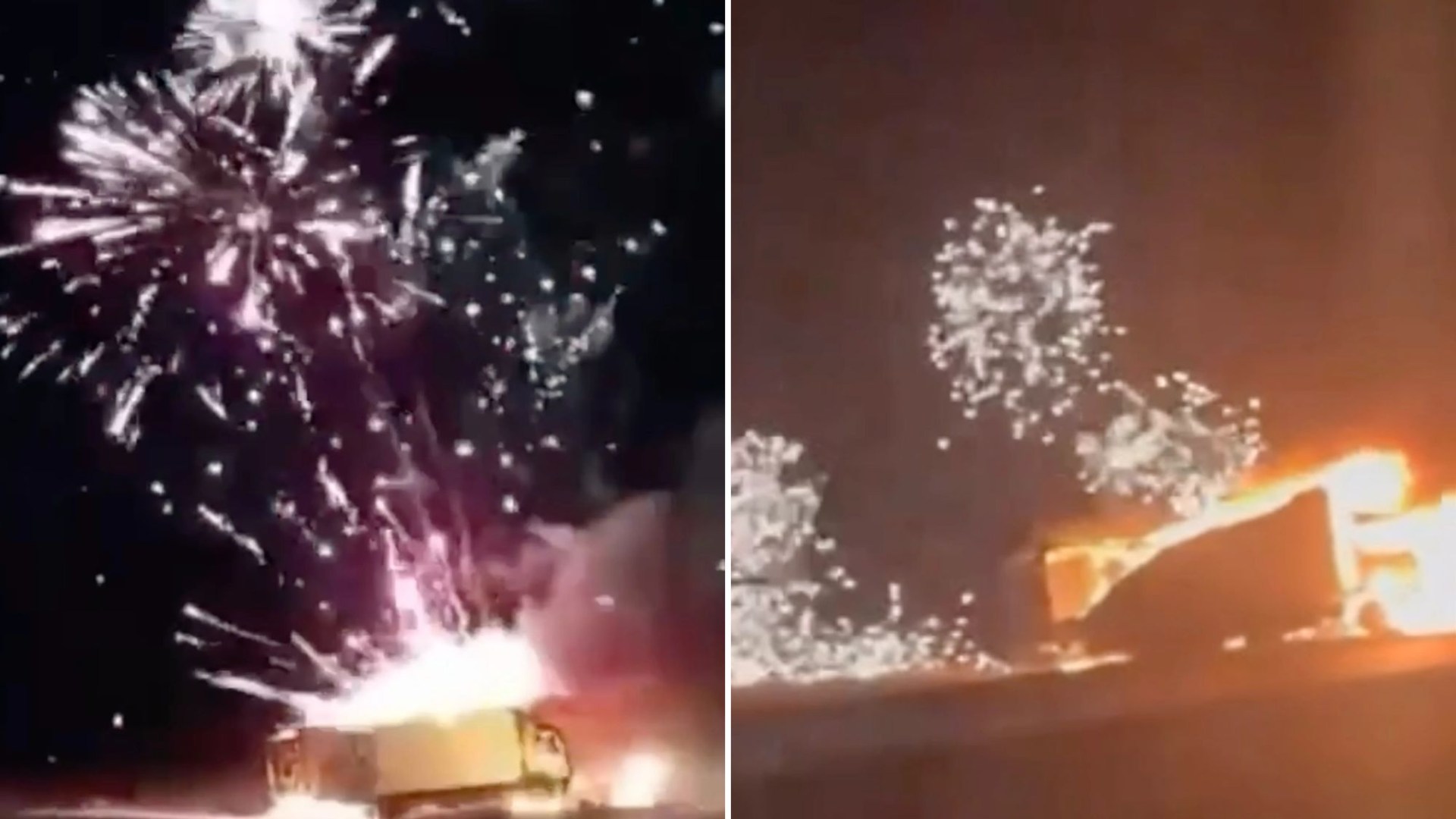
A Mercedes-Benz lorry transporting a large quantity of fireworks overturned and caught fire on the Almaty-Shelek-Khorgos highway in Kazakhstan, resulting in an unexpected and dramatic fireworks display. The accident, which occurred late at night, caused the fireworks to ignite, launching a barrage of rockets into the sky and creating a spectacular, albeit unplanned, show of light visible for miles. Onlookers described the unscheduled pyrotechnics as the best they’d ever witnessed. While the driver escaped unharmed and no other injuries were reported, the incident prompted an investigation into its cause. The fiery spectacle caused by the overturned lorry mirrors a recent trend of firework-related accidents involving vehicles.
This incident in Kazakhstan echoes a similar, though more tragic, event in Russia. In the village of Vozzhaevka, in Russia’s Amur region, a car collided with a truck carrying fireworks. The impact caused the truck to overturn and the fireworks to explode, resulting in a devastating fire. Tragically, two children, aged eight and eleven, lost their lives in the crash. The truck driver sustained serious injuries and was hospitalized. Emergency responders, including firefighters, rushed to the scene to extinguish the blaze and address the aftermath of the explosion. The force of the explosion damaged overhead power lines, leaving the village in darkness. Amidst the devastation, locals managed to rescue a cat that had been severely burned.
This Russian tragedy highlights the inherent dangers associated with transporting fireworks. The volatile nature of these pyrotechnic devices, coupled with the potential for traffic accidents, creates a hazardous combination. The incident in Vozzhaevka serves as a stark reminder of the importance of stringent safety regulations and meticulous handling procedures when transporting such explosive materials. The loss of two young lives underscores the potential for catastrophic consequences when these safety measures are not adhered to.
Furthermore, the incident in Russia follows a pattern of recent fireworks-related accidents, including an explosion at a fireworks factory in Elin Pelin, Bulgaria, three months prior. The factory explosion resulted in a massive fireball and mushroom cloud, leaving workers with horrific injuries, including third-degree burns. The blast, estimated to be equivalent to two tons of TNT, prompted officials to declare a partial state of disaster and urge residents of Elin Pelin and the neighboring town of Gara Elin Pelin to evacuate. The severity of this incident points to the inherent dangers present in fireworks manufacturing and storage facilities, highlighting the need for rigorous safety protocols and emergency preparedness measures.
The string of incidents extends to India, where a fireworks warehouse went up in flames in May following a spark from a nearby welding unit. Tragically, a warehouse worker died in the accident, and another suffered severe burns. This incident, along with another deadly explosion at a fireworks factory in Madhya Pradesh three months earlier that killed at least eight people and injured 80 others, emphasizes the need for improved safety standards and stricter enforcement in the fireworks industry, particularly in developing countries. These recurring incidents reveal a systemic issue concerning safety regulations and their implementation.
These accidents, occurring in different parts of the world and involving various aspects of the fireworks industry – transportation, manufacturing, and storage – underscore a global concern about fireworks safety. Whether it be the dramatic, yet fortunately non-fatal, highway incident in Kazakhstan, the devastating car crash in Russia, or the factory explosions in Bulgaria and India, these events emphasize the urgent need for enhanced safety measures throughout the entire fireworks lifecycle. The recurring nature of these incidents suggests a need for a more comprehensive approach to safety regulations, encompassing transportation, manufacturing, storage, and even the use of fireworks by the public.
The range of incidents also highlights the varying degrees of risk associated with fireworks. While the Kazakhstan incident resulted in a spectacular display with no casualties, the events in Russia and India led to significant loss of life and injury. This disparity underscores the importance of context-specific safety protocols. While strict regulations are crucial for manufacturing and storage facilities, proper handling procedures and secure transport are paramount when dealing with the transportation of fireworks. Public awareness campaigns regarding the safe use of fireworks are also essential to minimize the risk of accidents during celebrations and festivities. Ultimately, a multi-pronged approach addressing all aspects of the fireworks lifecycle is necessary to prevent future tragedies and ensure the safe enjoyment of these explosive devices.