



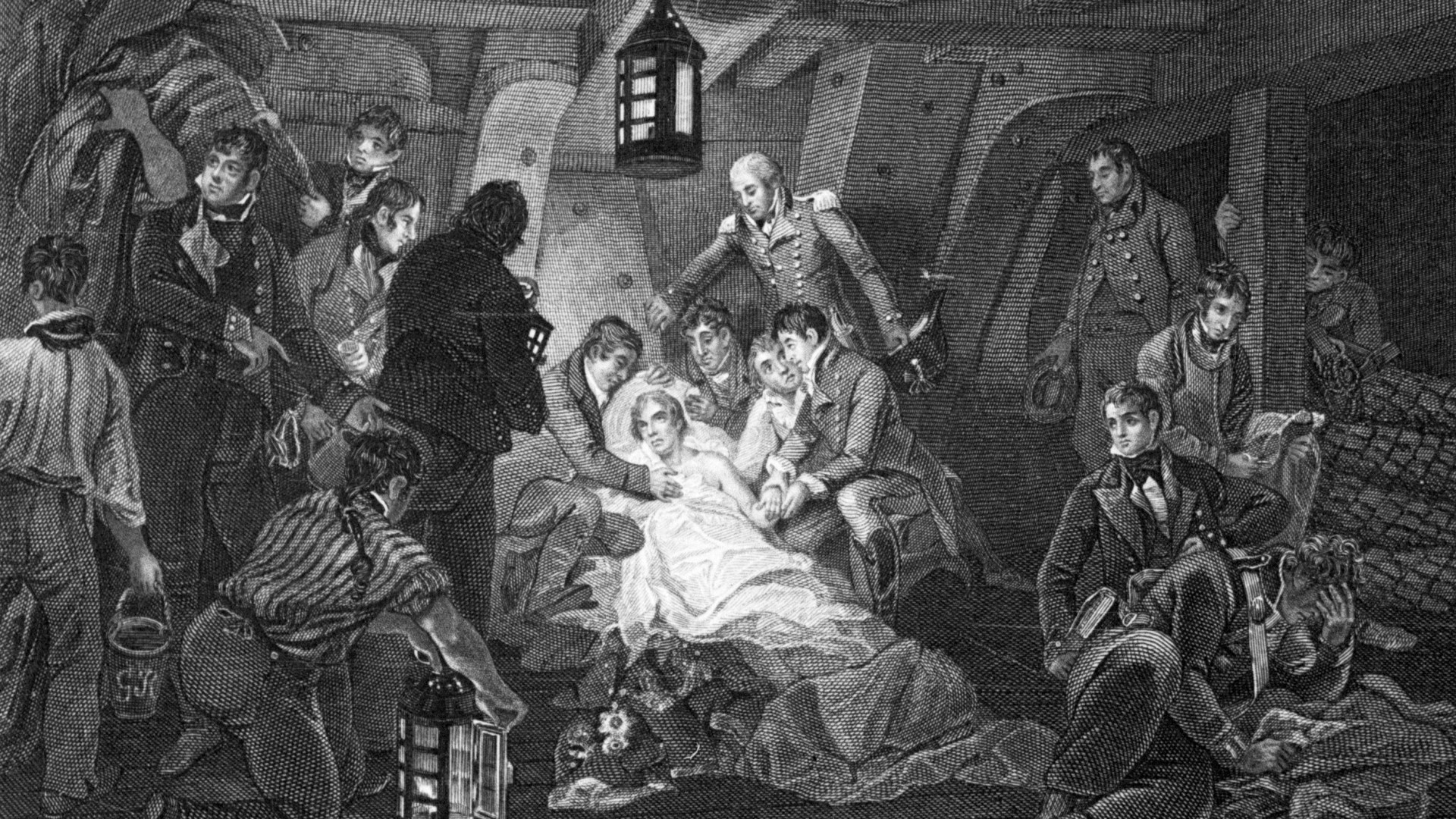
The prevailing narrative surrounding Lord Nelson’s final moments aboard HMS Victory during the Battle of Trafalgar has long centered on the poignant phrase, “Kiss me, Hardy.” However, a newly unearthed account challenges this widely accepted version of events, offering a different perspective on the admiral’s dying words. A letter penned by George Sievers, a master-at-arms stationed on HMS Belleisle, a ship in close proximity to Nelson’s flagship, recounts a less dramatic but equally profound final utterance: “Thanks be to God but I have lived this day and now I die content.” This alternative account, written just six days after the momentous battle, adds another layer of complexity to the historical record and prompts a reevaluation of the iconic scene.
Sievers’ letter, addressed to his landlord Thomas Tunnard in Lincolnshire, surfaces two centuries after the Battle of Trafalgar, offering a fresh glimpse into the immediate aftermath of the pivotal naval engagement. While the “Kiss me, Hardy” narrative has become firmly entrenched in popular culture and historical accounts, Sievers’ testimony introduces an element of doubt. His account, while not directly witnessed, was likely gleaned from conversations and reports circulating amongst the sailors in the immediate wake of the battle, providing a valuable contemporary perspective. This newly discovered document, set to be auctioned, opens a window into the dissemination of information and the evolution of historical narratives in the early 19th century.
The discrepancy between Sievers’ account and the established narrative raises important questions about the accuracy and reliability of historical accounts. While the “Kiss me, Hardy” version is supported by other sources, including testimony from individuals present on HMS Victory, Sievers’ letter highlights the potential for variations and interpretations to emerge, particularly in the chaos and confusion of a battlefield. The existence of multiple versions underscores the challenges historians face in reconstructing historical events and the importance of considering multiple perspectives. This newly discovered account serves as a reminder that history is not a monolithic, fixed entity but rather a tapestry woven from diverse threads of memory and interpretation.
The differing accounts of Nelson’s final words highlight the complexities inherent in historical narratives. The “Kiss me, Hardy” version, with its emotional resonance and dramatic flair, has undoubtedly contributed to its enduring popularity. It captures the intimacy and profound respect between Nelson and his flag captain, encapsulating the human drama amidst the larger historical event. However, Sievers’ account, though less dramatic, offers a different kind of insight into Nelson’s character and state of mind in his final moments. His expression of gratitude and contentment paints a picture of a man at peace with his accomplishments and fate, resonating with a different kind of emotional power.
The emergence of Sievers’ letter also underscores the importance of primary source materials in historical research. While secondary accounts and interpretations play a vital role in shaping our understanding of the past, primary sources, such as letters, diaries, and official documents, provide a more direct link to historical events. They offer a glimpse into the thoughts, emotions, and experiences of those who lived through those events, allowing us to reconstruct the past with greater nuance and accuracy. Sievers’ letter, though just two pages long, provides a valuable piece of the puzzle, enriching our understanding of the Battle of Trafalgar and its aftermath.
The auction of Sievers’ letter provides an opportunity for further scholarly investigation into the events surrounding Nelson’s death and the Battle of Trafalgar. The letter’s content, combined with existing historical records, can be further analyzed to gain a deeper understanding of the context and circumstances surrounding Nelson’s final words. The discrepancy between Sievers’ account and the established narrative encourages historians to re-examine the existing evidence and consider alternative interpretations. This process of continuous inquiry and reevaluation is essential to the pursuit of historical accuracy and a more complete understanding of the past. The rediscovery of this letter serves as a reminder that the exploration of history is an ongoing journey, and new discoveries can always challenge our assumptions and reshape our understanding of the past.