





The tantalizing prospect of traversing the Atlantic Ocean between London and New York in a mere hour has resurfaced, reigniting discussions about a transatlantic train tunnel. While the concept isn’t novel, advancements in technology, particularly in vacuum tube systems and pressurized vehicles, have breathed new life into what was once considered an impossible feat. This audacious project envisions a 3,000-mile underwater tunnel facilitating high-speed train travel, potentially revolutionizing intercontinental travel and offering a more environmentally friendly alternative to air travel. However, the colossal estimated cost of £15 trillion presents a formidable challenge to its realization.
The proposed transatlantic train system draws inspiration from the hyperloop concept, employing pressurized tunnels to eliminate wind resistance and enable trains to reach speeds of up to 3,000 mph. This technology, similar to that being explored by Swiss engineers in their superloop trials, aims to drastically reduce travel time and minimize the environmental impact associated with traditional air travel. The absence of air resistance within the sealed tunnels would allow trains to achieve unprecedented velocities, making the one-hour journey between London and New York a tangible possibility. However, the feasibility of maintaining such a complex system over such a vast distance remains a significant hurdle.
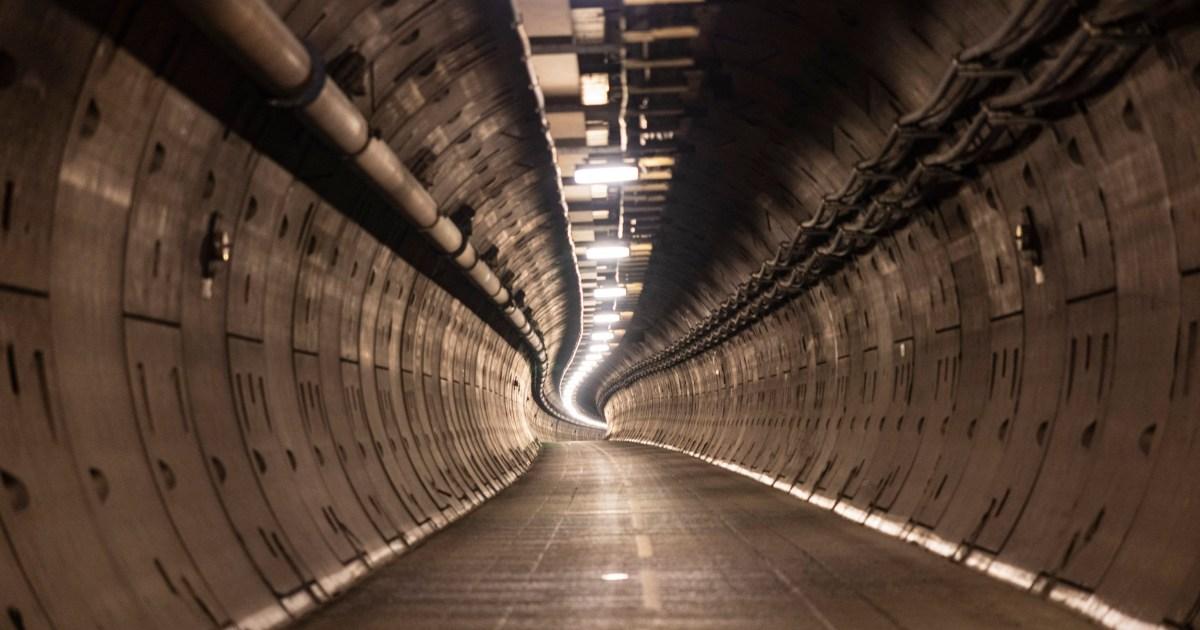
While the transatlantic tunnel project presents a monumental engineering challenge, the Channel Tunnel serves as a tangible, albeit smaller-scale, example of underwater tunnel construction. Spanning less than 40 miles and connecting the UK and France, the Channel Tunnel’s six-year construction period offers a glimpse into the complexities involved in such endeavors. The proposed Atlantic tunnel, however, dwarfs the Channel Tunnel in both length and complexity. Engineers are exploring various approaches, including burying the tunnel beneath the ocean floor or suspending it using cables or stilts, each presenting unique technical and logistical challenges. The depth of the proposed tunnel would also significantly surpass that of the Channel Tunnel, which reaches a maximum depth of 245 feet.
The idea of underwater tunnels is not new. As early as 1802, French mining engineer Albert Mathieu-Favier envisioned a tunnel connecting France and England, complete with oil lamps and an artificial island for changing horses. This historical precedent highlights the enduring human fascination with connecting distant lands through ambitious engineering projects. Unlike the proposed transatlantic tunnel, the Channel Tunnel is not pressurized and does experience some water leakage, which is subsequently pumped out. This highlights the difference in technological complexity between the existing Channel Tunnel and the envisioned transatlantic tunnel, which would require maintaining a pressurized environment for high-speed travel.
The potential benefits of a transatlantic train tunnel are substantial. Beyond the dramatic reduction in travel time, the project promises significant environmental advantages. By replacing air travel, a major contributor to air pollution, with a high-speed rail system, the tunnel could contribute to a greener future. The economic implications are also significant, potentially fostering trade and tourism between the connected continents. However, the massive financial investment required raises questions about funding mechanisms and the long-term economic viability of such a project.
Despite the daunting challenges, the resurgence of the transatlantic train tunnel concept underscores the enduring human drive to push the boundaries of engineering and redefine the possibilities of transportation. While the technical hurdles remain substantial, advancements in vacuum tube technology, pressurized vehicles, and tunnel construction techniques suggest that this ambitious project may not be as far-fetched as it once seemed. The potential benefits of this transformative project, including reduced travel time, environmental sustainability, and economic growth, make it a compelling vision for the future of intercontinental travel. Whether this ambitious undertaking will become a reality remains to be seen, but the renewed interest signals a continued fascination with connecting the world in innovative ways.