





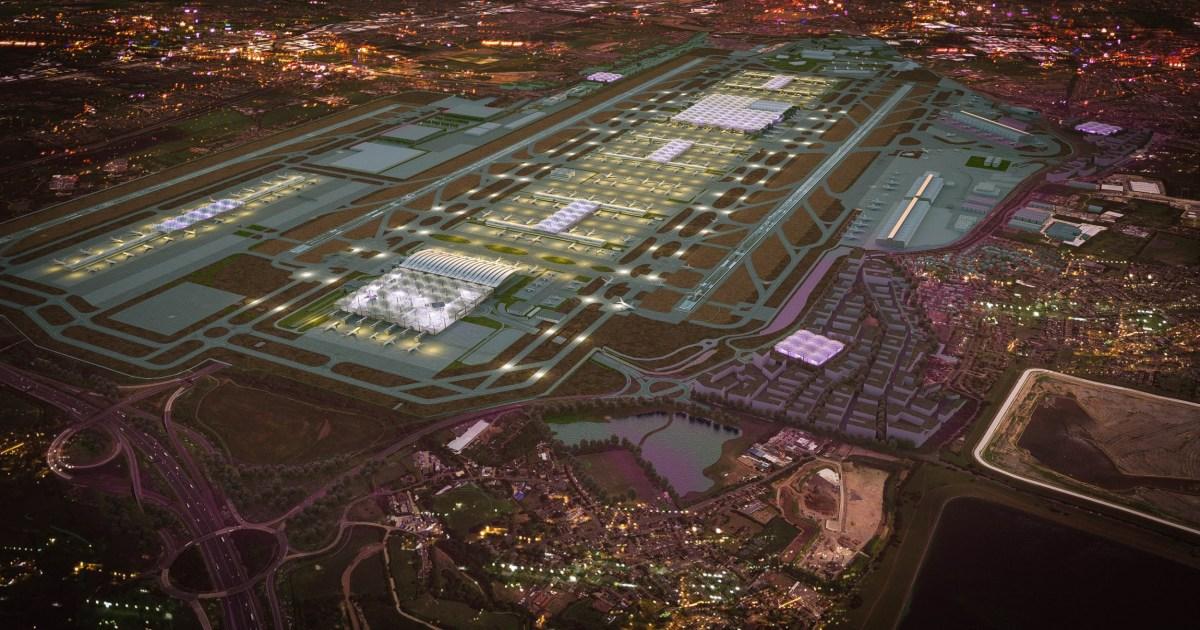
Heathrow Airport, the UK’s busiest airport, is poised for a significant expansion with the potential addition of a third runway. This £14 billion project aims to increase the airport’s capacity, adding an estimated 260,000 flights annually. Airport authorities argue that Heathrow is currently operating at full capacity, handling a record 83.9 million passengers last year, and that the expansion is crucial for boosting economic growth and facilitating international trade. They emphasize the airport’s role in enabling over £200 billion of British trade annually and contend that increasing capacity is essential for continued economic prosperity. While Heathrow officials have refrained from commenting directly on the potential government approval, they underscore their commitment to upgrading existing infrastructure and exploring options for the third runway while adhering to stringent environmental regulations related to carbon emissions, noise pollution, and air quality.
However, the proposed expansion faces strong opposition from environmental groups and local residents. Concerns center on the environmental impact of the increased air traffic, particularly the rise in carbon emissions. Critics argue that such an expansion contradicts the government’s commitment to climate leadership and would disproportionately benefit frequent flyers, a small segment of the population. Residents living near the airport also fear the loss of their homes and the disruption to their communities. Alethea Warrington, representing the climate charity Possible, has voiced strong criticism, characterizing the potential emissions increase as a “catastrophic misstep” for a government claiming to be a climate leader. She emphasizes the negative environmental consequences and questions the economic benefits, arguing that the expansion primarily caters to a small group of frequent flyers.
The expansion plans, initially approved by Parliament in 2018, have been stalled by legal challenges. Recent reports suggest that Chancellor Rachel Reeves is likely to approve the Heathrow expansion, alongside expansions at Gatwick and Luton airports, as part of a broader strategy to stimulate economic growth. While the government has not officially confirmed this decision, their statement emphasizes the importance of economic growth and the aviation sector’s long-term future. They maintain that any expansion proposals must demonstrate a positive contribution to economic growth while adhering to existing environmental regulations. The timing of the announcement remains uncertain, but speculation points towards the Chancellor’s upcoming speech on economic growth.
The proposed expansion project involves a complex interplay of economic and environmental considerations. Proponents argue that the increased capacity is vital for economic growth, facilitating international trade and creating jobs. They highlight the airport’s current limitations and the need for expansion to maintain the UK’s competitiveness in the global aviation market. Heathrow Airport emphasizes its commitment to sustainable development, stating that the expansion will be carried out in line with strict environmental standards. They point to the economic benefits of increased trade and connectivity, arguing that the expansion is necessary to support the UK’s long-term economic prosperity.
Opponents, however, contend that the environmental costs outweigh the potential economic benefits. They express concerns about the increase in carbon emissions, noise pollution, and the impact on local communities. Environmental groups argue that the expansion contradicts the government’s climate goals and calls for a more sustainable approach to aviation development. They advocate for investments in alternative transportation methods and a greater focus on reducing emissions within the existing aviation infrastructure. The clash between economic development and environmental protection highlights the challenges of balancing competing interests in infrastructure projects.
The final decision on the Heathrow expansion rests with the government, which must carefully weigh the economic benefits against the environmental consequences. The Chancellor’s upcoming announcement will likely clarify the government’s position and set the stage for the next phase of this contentious project. The decision will have significant implications for the UK’s aviation sector, the environment, and the communities surrounding Heathrow Airport. The ongoing debate reflects the broader challenge of reconciling economic growth with environmental sustainability in a rapidly changing world.