





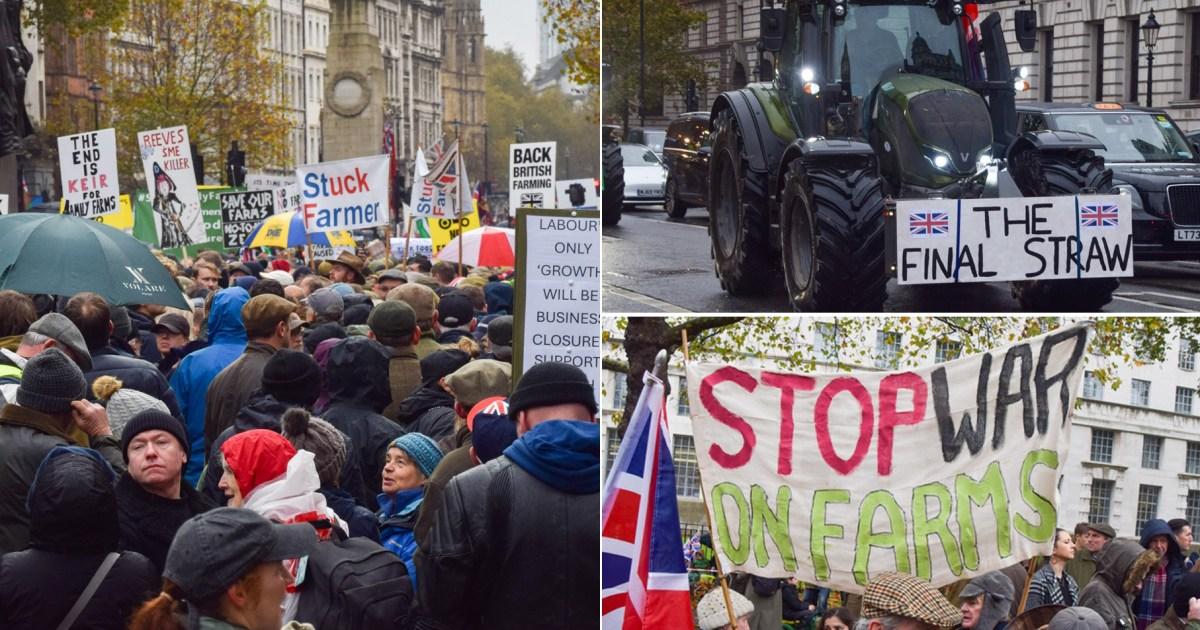
The British agricultural landscape is bracing for another wave of protests as farmers mobilize to challenge recent inheritance tax reforms introduced by the Labour government. These reforms, unveiled in last month’s budget, propose eliminating the long-standing inheritance tax exemption for farms with assets exceeding £1 million. This change has ignited a firestorm of criticism from the farming community, who argue that it poses an existential threat to family farms and the nation’s food security. Organised under the banner of “RIP British Farming,” the protests signal a growing discontent with government policies perceived as detrimental to the agricultural sector. This latest demonstration follows a significant rally last month that drew thousands of participants, including prominent figures like Jeremy Clarkson and Andrew Lloyd Webber, alongside politicians from various parties.
Today’s protest is anticipated to be a significant display of the farming community’s frustration, with hundreds of tractors expected to converge on Westminster from across the country. The planned “go-slow” protest, involving tractors lining Whitehall and a slow drive through central London, aims to disrupt the capital and draw attention to the farmers’ plight. Organizers, including Liz Webster of Save British Farming, have vehemently criticized the government’s move, likening it to a “Stalinist offensive” and emphasizing the vital role of food security for the entire nation. The timing of the protest coincides with the government’s release of a report on UK food security, further highlighting the tension between the government’s policies and the farming sector’s concerns.
In the lead-up to the protest, the Department for Environment, Food, and Rural Affairs (Defra) has sought to emphasize its commitment to supporting the agricultural industry. Defra highlighted recent investments in the rural economy, including £343 million allocated for nature-friendly farming practices, benefiting over 31,000 farmers. Furthermore, details of the government’s environmental land management schemes were announced, which incentivize farmers to adopt sustainable practices that contribute to environmental protection and restoration. Environment Secretary Steve Reed underscored the government’s “steadfast” commitment to farmers, referencing a £5 billion two-year farming budget, touted as the largest ever dedicated to sustainable food production in the UK.
Despite these assurances, the farming community remains unconvinced and maintains that the inheritance tax changes will have devastating consequences for family farms. They argue that the increased tax burden will force many farmers to sell their land, leading to the fragmentation of farms and undermining the long-term viability of the agricultural sector. This, they believe, will ultimately threaten the nation’s food security, making the UK more reliant on imported food. The farmers’ concerns have been echoed by some politicians and industry experts, who warn of the potential for unintended consequences from the government’s policy.
The government, however, remains resolute in its stance. A spokesperson for Prime Minister Keir Starmer reiterated the government’s commitment to the policy, emphasizing the necessity of difficult decisions in the budget and spending review. While acknowledging the concerns of farmers, the spokesperson reiterated the government’s commitment to the agricultural sector through the substantial funding allocated in the farming budget. This apparent impasse between the government and the farming community sets the stage for a continued battle over the future of British agriculture. The protest serves as a stark reminder of the complex challenges facing the sector, caught between the need for economic sustainability and the demands of environmental protection.
The escalating tensions between the government and the farming community reflect a deeper debate about the future of British agriculture. The government argues that the inheritance tax reforms are necessary to ensure a fairer distribution of wealth and to fund essential public services. Farmers, on the other hand, view these reforms as a direct attack on their livelihoods and a betrayal of the government’s commitment to supporting the rural economy. The protests, therefore, represent not just a fight over inheritance tax, but a broader struggle over the direction of agricultural policy and the role of farming in a rapidly changing world. The government’s emphasis on sustainable food production, while welcomed by many, appears insufficient to address the immediate concerns of farmers facing the prospect of losing their family farms. This disconnect will likely continue to fuel discontent within the farming community and necessitate further dialogue to find a way forward that balances economic realities with the need to preserve a vibrant and sustainable agricultural sector.