




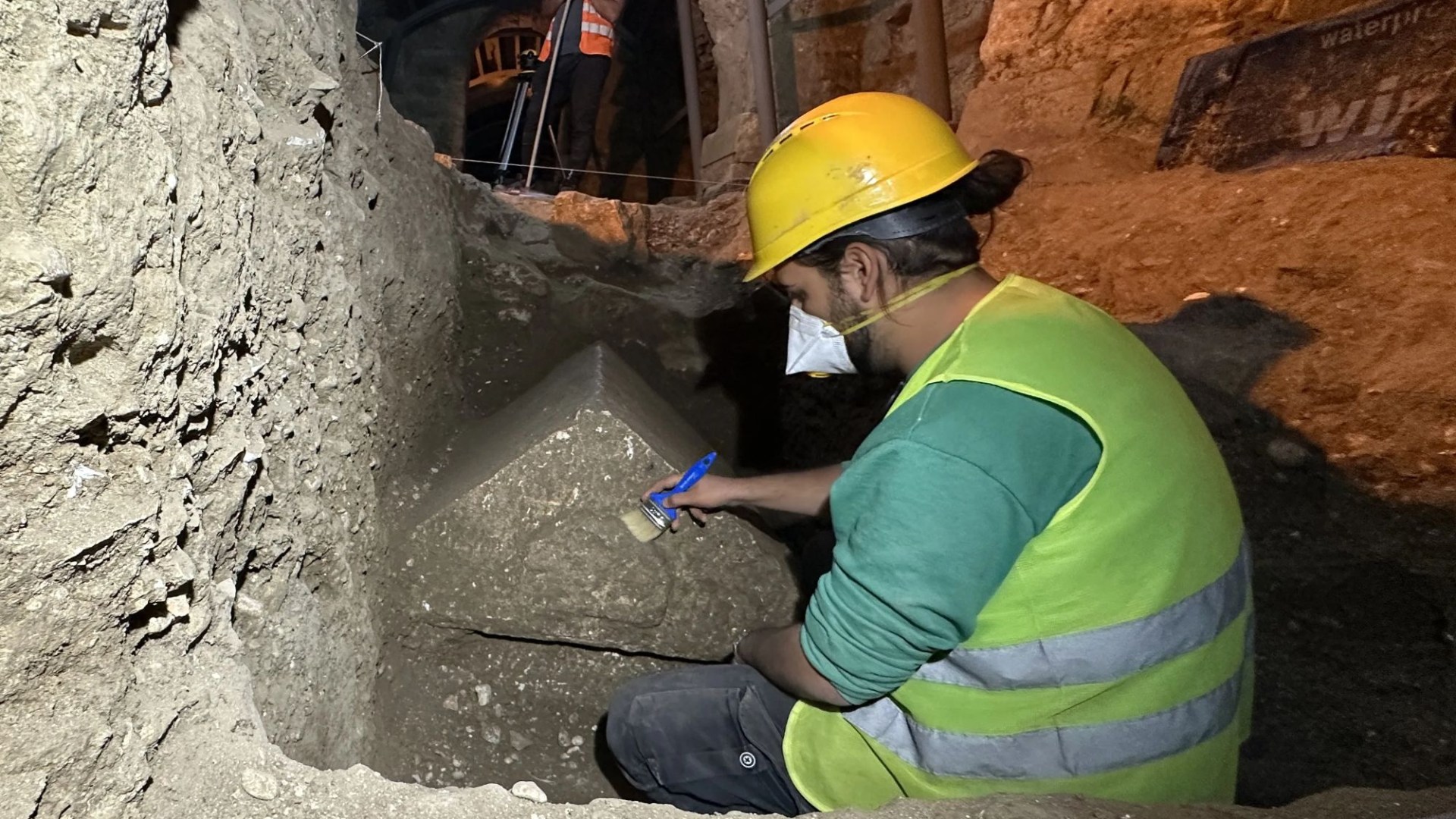
The ongoing excavation at St. Nicholas Church in Demre, Turkey, the site of ancient Myra, has yielded a significant discovery: a limestone sarcophagus potentially belonging to St. Nicholas himself, the 4th-century bishop who inspired the legendary figures of Santa Claus and Sinterklaas. The discovery, made within a two-story annexe of the church, marks a pivotal moment in the search for the final resting place of this revered Christian figure. The sarcophagus, measuring five feet deep and six feet long with a raised lid, was found six feet underground within what archaeologists now believe to be the original burial site of the 7th-century church. Its location aligns with historical accounts suggesting St. Nicholas was buried near the sacred area of Myra, lending credence to the possibility that this is indeed his tomb. The discovery of the sarcophagus was preceded by findings of animal bones and clay lamp fragments, indicating the presence of a burial site. This revelation holds significant archaeological value, corroborating historical texts and potentially resolving the long-standing mystery surrounding St. Nicholas’s burial location.
St. Nicholas of Myra, a Greek bishop who lived from approximately 270 AD to 343 AD, became a legendary figure due to his profound generosity and commitment to helping the needy. He used his inheritance to aid those less fortunate and was known for his anonymous gift-giving, particularly the practice of leaving coins in people’s shoes. This act of kindness became a cornerstone of the Santa Claus tradition, linking the historical figure to the modern-day symbol of Christmas giving. Stories of his miraculous interventions, such as saving sailors from storms and resurrecting children, further solidified his sainthood and cemented his place in Christian lore.
The unearthing of the sarcophagus adds another layer to the intriguing story of St. Nicholas. While the identity of the remains within hasn’t been confirmed, its proximity to the church strengthens the belief that it could indeed be the saint’s final resting place. Over the centuries, the remains attributed to St. Nicholas have been subject to relocation and division. In 1087, Italian sailors removed some bones from the original sarcophagus and transported them to Bari, Italy. Later, during the First Crusade, Venetian sailors acquired the remaining bones. Scientific analysis in 1953 confirmed that both sets of bones belonged to the same individual, although conclusive proof that they belong to St. Nicholas remains elusive.
The ongoing research at St. Nicholas Church focuses on uncovering further details about the sarcophagus. Archaeologists hope to find an inscription that could shed light on the tomb’s contents and confirm its age. The excavation team, led by Associate Professor Ebru Fatma Findik, expresses optimism about the potential for a definitive identification. They anticipate unveiling more findings in the coming months, potentially providing crucial evidence to confirm the sarcophagus’s connection to St. Nicholas.
Adding to the renewed interest in the historical figure, separate research has successfully reconstructed St. Nicholas’s face using data collected in the 1950s. Employing advanced 3D modeling techniques and anatomical deformation based on a living person’s tomography, researchers have created both objective greyscale images and more artistic representations, complete with a beard and clothing inspired by traditional iconography. This facial reconstruction offers a glimpse into the appearance of the man behind the legend, further humanizing the saint who has captured the imagination of generations.
The enduring legacy of St. Nicholas transcends his historical existence. His acts of charity and compassion, coupled with the tales of miracles attributed to him, have shaped his image into a symbol of selfless giving and unwavering faith. From his origins as a 4th-century bishop to his evolution into the beloved Santa Claus and Sinterklaas figures, his story continues to resonate across cultures and time. The discovery of the sarcophagus in Demre rekindles the fascination with his life and provides a tangible link to the man who inspired one of the most enduring and cherished figures in popular culture. This archeological find offers a unique opportunity to further explore the historical context surrounding St. Nicholas and potentially confirm the final resting place of the saint who became synonymous with the spirit of giving.