




Constance Markievicz, a figure largely obscured in British political narratives, holds a significant place in Irish history as a revolutionary, politician, and advocate for Irish independence. Born into an aristocratic Anglo-Irish family in 1868, Markievicz defied societal expectations by pursuing her artistic passions and embracing a life of activism. Her transformation from a London socialite to a fervent Irish nationalist showcases a compelling story of personal conviction and political commitment. This journey, fueled by her artistic spirit and deep connection to Ireland, led her to become a key figure in the fight for Irish independence, challenging British authority and paving the way for a new political era. Her legacy, although complex and at times controversial, continues to resonate in Ireland and beyond, particularly for her groundbreaking role as the first woman elected to the British Parliament.
Markievicz’s early life was marked by privilege and a traditional upbringing. However, her artistic inclinations led her to Paris, where she honed her skills and married a Polish count. Upon settling in Dublin in 1903, she became immersed in the city’s vibrant artistic and political landscape. This environment, charged with nationalist sentiment and the burgeoning movement for Irish independence, profoundly influenced her. Markievicz rapidly transitioned from a life of relative comfort to one of political activism, joining Sinn Féin and the women’s paramilitary organization Inghinidhe na hÉireann. Her commitment to the nationalist cause deepened, leading her to actively participate in the 1916 Easter Rising, a pivotal moment in the struggle for Irish independence.
The Easter Rising cemented Markievicz’s status as a prominent figure in the Irish rebellion. Her active involvement in the armed uprising, including her role as second-in-command at St Stephen’s Green, demonstrated her unwavering dedication to the cause. Despite facing a death sentence, which was later commuted to life imprisonment due to her gender, her resolve remained unshaken. This experience further solidified her commitment to Irish independence and fueled her political ambitions. The events of 1916 served as a turning point, not only for Ireland but also for Markievicz personally, transforming her into a symbol of resistance and a champion for self-determination.
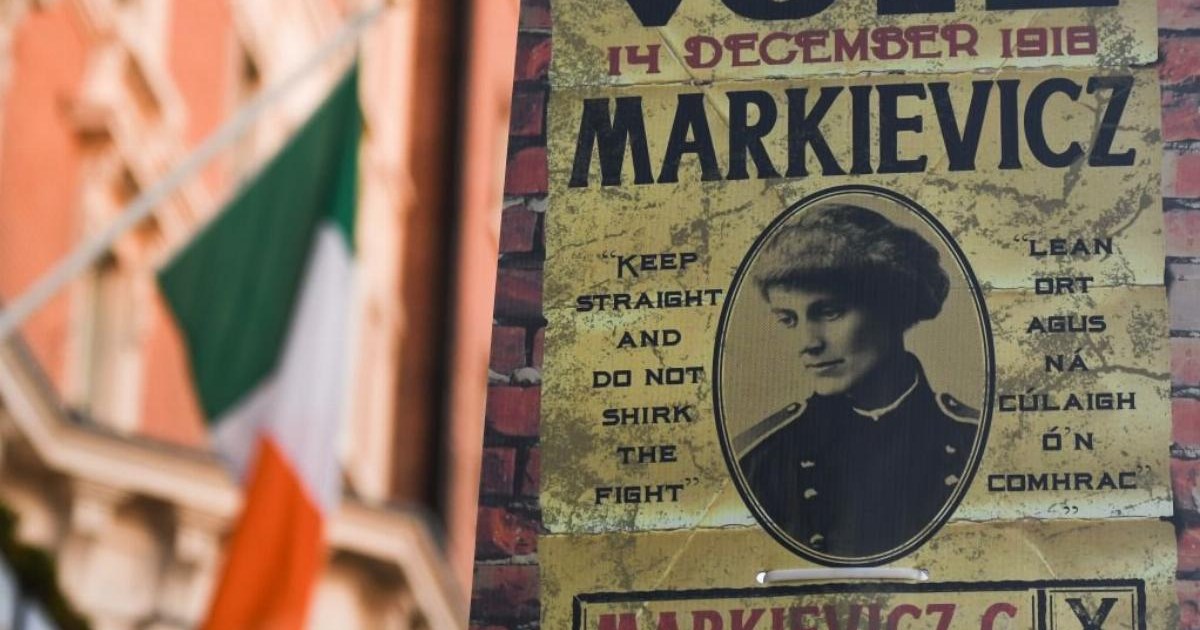
The 1918 general election marked a watershed moment in British political history, as it was the first election in which women were allowed to vote. In a groundbreaking victory, Constance Markievicz was elected as the Member of Parliament for Dublin St Patrick’s. This historic achievement positioned her as the first woman to be elected to the British House of Commons. However, in accordance with Sinn Féin policy, she refused to take her seat at Westminster, choosing instead to participate in the newly formed First Dáil, the revolutionary parliament established in Dublin. This act of defiance underscored her unwavering commitment to Irish self-governance and her rejection of British authority. Her subsequent appointment as Ireland’s first Minister for Labour further solidified her position as a pioneering figure in Irish politics.
Despite her groundbreaking election to the British Parliament, Markievicz’s political career continued to be intertwined with the turbulent struggle for Irish independence. Her opposition to the Anglo-Irish Treaty of 1922, which partitioned Ireland, led her to resign from her ministerial position. This decision reflected her unwavering commitment to a fully independent and unified Ireland. She subsequently joined Fianna Fáil and was elected to the Dáil in 1927. However, her long years of tireless activism had taken a toll, and she passed away shortly after her election, aged 59. Her death marked the end of a remarkable life dedicated to the pursuit of social justice and Irish self-determination.
Constance Markievicz’s legacy continues to be a source of inspiration and debate. Her multifaceted life as an artist, aristocrat, and revolutionary highlights her complex and often contradictory nature. While her refusal to take her seat in the British Parliament meant that another woman, Nancy Astor, is often remembered as the first woman to sit in the House of Commons, Markievicz’s election remains a historically significant event. Her contribution to Irish politics and her unwavering commitment to the cause of Irish independence have cemented her place as a prominent figure in Irish history. Her story serves as a powerful reminder of the transformative power of individual conviction and the enduring impact of those who dare to challenge the status quo.